


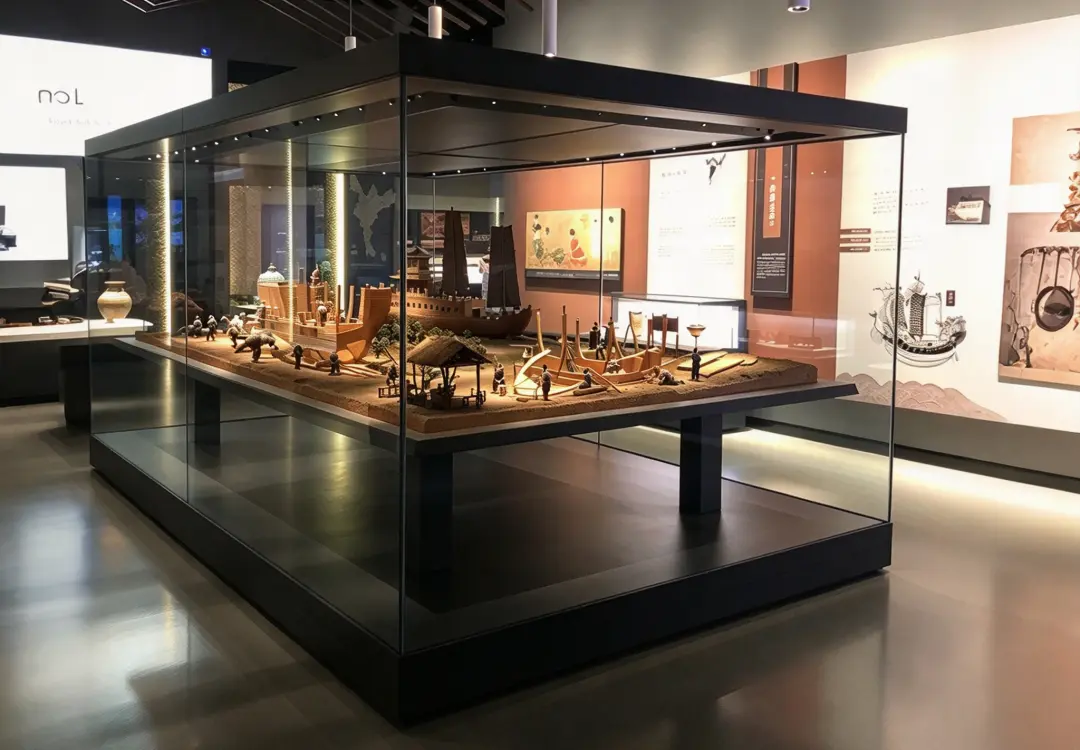
I walked a Guangzhou assembly line at 2 a.m. last October chasing a seal failure that had fogged the anti-reflective glass on a bank of freestanding museum display cases bound for Stuttgart. The culprit wasn’t the glass. It was a batch of neutral-cure structural silicone substituted to hit a delivery date – a 0.3 mm bead variance that turned a 0.1 d^-1 microclimate into a 1.4 d^-1 leak. By the time the crate landed, the relative humidity inside had swung 18 points and a silver filigree exhibit had begun tarnishing. That is the margin we work in. A museum freestanding display case is not a glass box; it is a sealed structural pressure vessel that must hold a microclimate for decades while absorbing 360-degree visitor traffic, seismic micro-tremors, and the slow chemical aggression of its own interior case materials.
At Museo, our protocol starts on the CAD/CAM bench, not in a marketing deck. Whether the spec calls for localized pedestal cases or an expansive Large Island Display Cabinet, structural integrity rests on high-precision cold-rolled steel framing and structural silicone bonding – not mechanical fasteners that back out under thermal cycling.
How Do You Build a Museum Freestanding Display Case That Holds Sub-0.1 Air Exchange Rates?
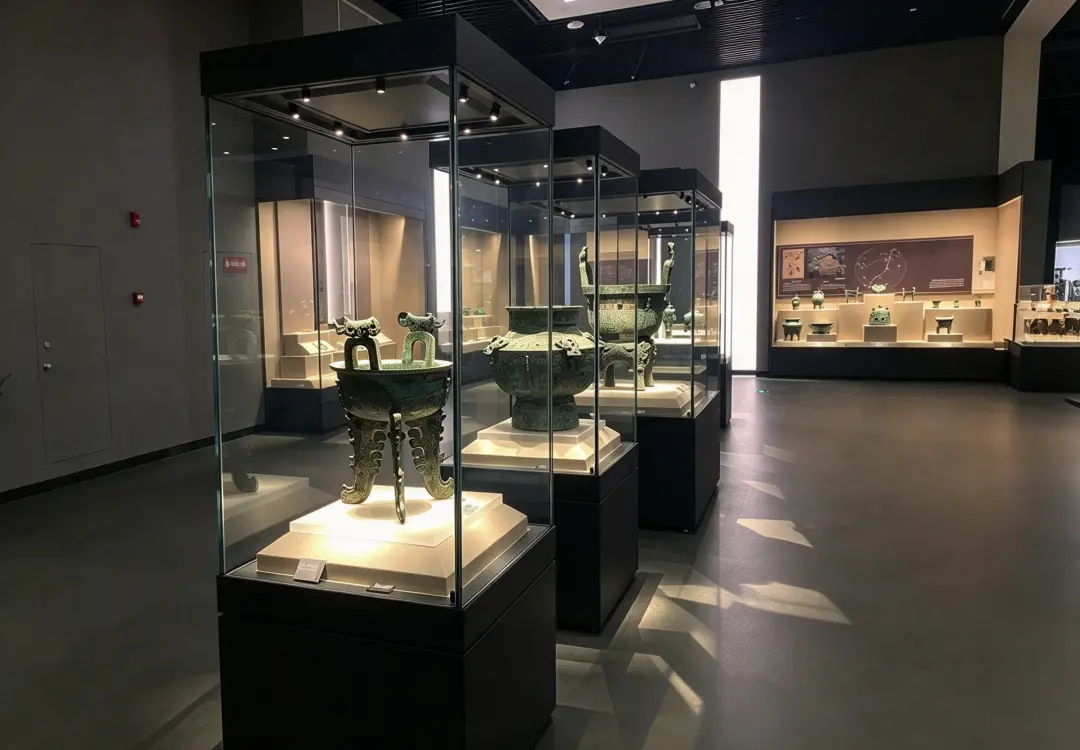
Microclimate stability in sealed cases comes down to one number: the Air Exchange Rate (AER). Off-the-shelf commercial glass cases leak at 1.0 to 2.0 air changes per day (d^-1). For organic artifacts, delicate textiles, or antiquities sensitive to relative humidity swings, that leakage rate is a decay engine. Our factory gate mandates an AER below 0.1 d^-1 – and on rigorous project specs, down to 0.05 d^-1. Hitting that number demands three structural elements, and none of them are optional.
Precision-machined aluminum extrusions, CNC-milled to tolerances under 0.1 mm, prevent frame deflection along long-span glass panels. Continuous vulcanized EPDM gaskets hold elastic rebound across thousands of compression cycles without taking a permanent set or releasing phthalates into the case air. Below the display deck, concealed passive buffering chambers house silica gel cassettes or active climate control units – letting museum staff recharge desiccant trays through dedicated access panels without ever opening the primary vitrine to gallery airflow.
That last point matters more than buyers think. Every time a curator cracks a case door to swap a PROSorb tray, the microclimate they spent six weeks stabilizing is gone in 90 seconds. Humidity control is not a sticker you add at the end; it is designed into the case construction from the first extrusion drawing.
What Structural Engineering Keeps Freestanding Museum Display Cases Stable Under Gallery Traffic?
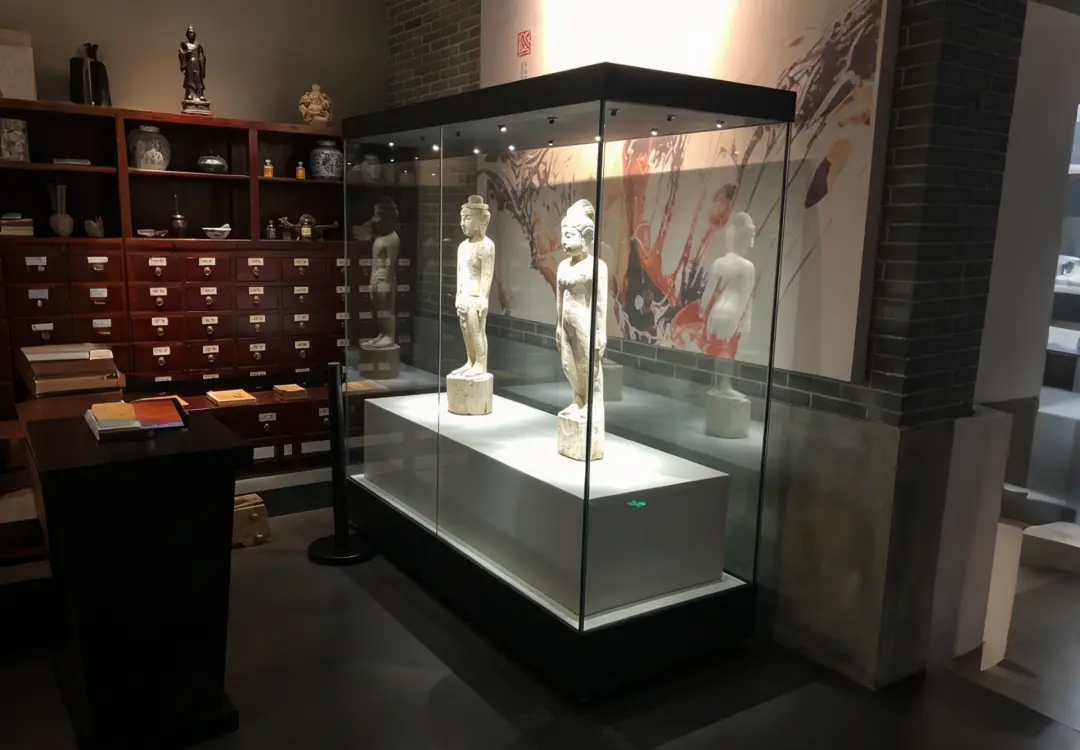
The threat to a freestanding case isn’t only humidity. It is structural shear and vibration from heavy foot traffic and seismic micro-tremors. When curators request continuous four-sided viewing with no vertical corner mullions, the entire cantilever load lands on the glass joints and mitigation hardware. That’s where amateur fabrication fails first.
We specify low-iron, extra-clear toughened laminated glass bonded with SentryGlas (SGP) interlayers. SGP gives five times the tear strength and 100 times the rigidity of standard PVB film – and when a panel breaks, it holds the heavy glass upright instead of sagging into the exhibit space. On multi-ton builds like a Large Island Display Cabinet, our engineers tuck concealed structural counterweights and hydraulic motorized lifting mechanisms into the base pedestal. A single operator lifts a 300 kg glass vitrine by remote – no frame racking, no gasket displacement, no manual-lifting accidents.
I have seen a poorly balanced island case rack 4 mm on its first open cycle and shear the seal in one motion. The fix is engineering, not caution tape. Acrylic cases have their place in low-security retail, but for unobstructed 360-degree viewing of high-value artifacts, the case system has to be laminated glass on a steel chassis – period.
Why Is LED Showcase Lighting Architecture the Deciding Factor for Artifact Safety?
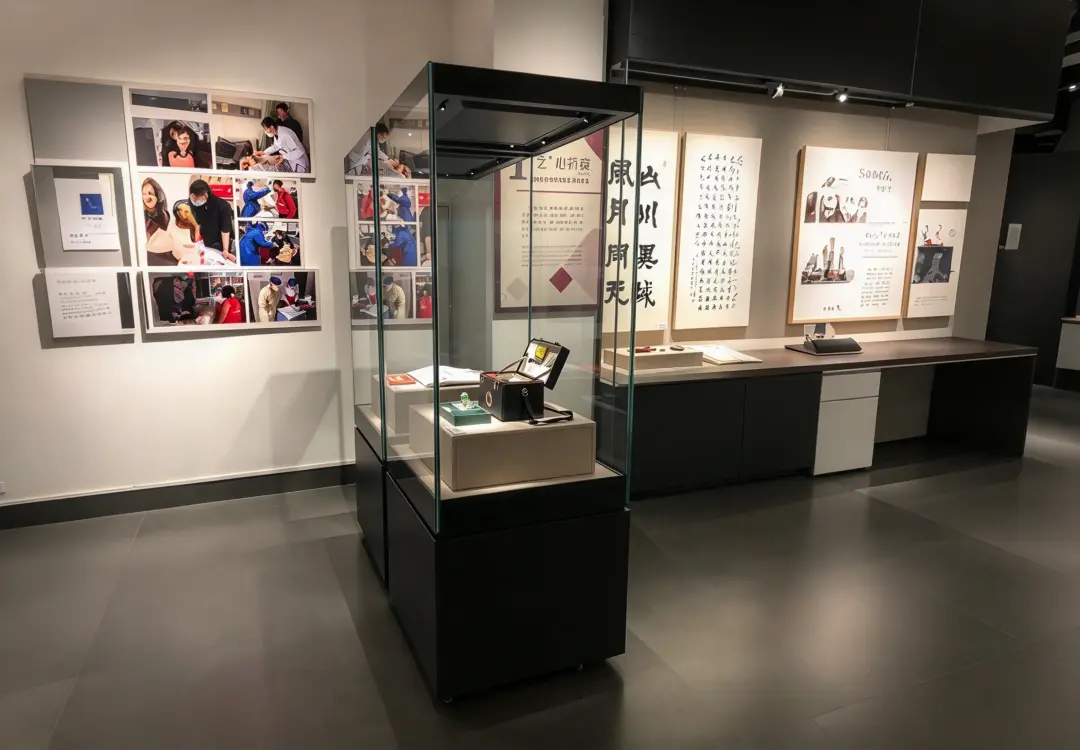
Lighting inside an exhibition display must solve a paradox: maximum visual acuity and color fidelity for visitor experience, with zero photochemical degradation from ultraviolet and infrared radiation. Traditional overhead lighting mounted inside a sealed cabinet fails on two fronts – internal heat accumulation, and localized thermal expansion that stresses the microclimate you just spent a paragraph engineering.
We decouple the light engine from the case environment entirely. High-CRI (Ra >= 97, R9 >= 90) COB LED arrays and motorized zoom spotlights sit in isolated attic compartments above UV-filtering glass panels; thermal energy dissipates upward into the gallery void, leaving the case interior untouched. For ultra-sensitive organic textiles, fiber optic lighting heads powered by remote illuminators feed light through flexible conduit – zero electrical current, zero heat, zero UV inside the showcase. The illumination arrives; the damage to objects does not. Exhibition designers who mount led lighting directly inside a sealed vitrine are buying themselves a humidity swing and a yellowing sapphire display within two seasons.
Which Case Materials Pass Oddy Testing and Protect Items on Display?
Material selection separates a short-term retail fixture from a conservation-grade museum display case. Every raw material must pass Oddy Testing – a 28-day accelerated corrosion test exposing silver, lead, and copper coupons to enclosure materials under elevated temperature and relative humidity. Standard MDF, polyurethane paints, and off-the-shelf sealants fail routinely by off-gassing acetic acid and formaldehyde, tarnishing silver and bronzing patinas within weeks.
Our material matrix runs zero-VOC powder-coated steel interior decks, anodized aluminum mounts, non-outgassing neutral-cure structural silicones, and inert conservator-grade fabrics – washed cotton, polyethylene-backed felts. If a supplier cannot hand you an Oddy test report, that is a trap. Walk away. The same logic applies to the case size decision: bigger is not more impressive, it is more surface area off-gassing into a sealed volume. Design and material are the same conversation.
How Should Curators Evaluate Custom Exhibition Display Cases Before Factory Acceptance?
Before signing off on factory acceptance testing (FAT) for a temporary exhibition or permanent gallery, procurement teams and exhibition designers should enforce three measurable gates. Pressure decay or tracer gas testing to prove the AER before crates leave the plant – no test, no shipment. Optic distortion inspection confirming low-iron glass holds anti-reflective coating uniformity (under 1% visible light reflectance) without color shift at oblique viewing angles. And mechanical deflection testing: glass doors at full open position must not deflect beyond 0.5 mm at the hinges and hydraulic actuators, or the locking latch will misalign within a few thousand cycles.
If you are specifying a build right now, this is the work we actually do. Museo ships freestanding museum display cases, large island cabinets, wall cases, and pedestal cases engineered against these exact failure modes – Cpk gates on glass tempering logged before anything leaves Guangzhou, vulcanized gasket cycles recorded, Oddy-tested interior materials on file. On a recent Stuttgart museum retrofit we tooled a custom brass hinge system to hit a 50,000-cycle spec because the off-the-shelf hardware could not. Bring us the spec, the artifact profile, and the gallery conditions. We will tell you straight what is buildable and what is a risk.
FAQs
Q1: What Air Exchange Rate should a conservation-grade museum freestanding display case hit?
AER at or below 0.1 d^-1 – meaning under 10% of internal air volume exchanges with gallery air per 24 hours. On sensitive organic artifacts we target 0.05 d^-1. Above 0.5 d^-1, relative humidity swings will drive irreversible decay within months.
Q2: Why specify anti-reflective (AR) laminated glass instead of standard float glass?
AR coating drops visible light reflectance from roughly 8% to under 1%, making the enclosure near-invisible under bright gallery lighting while filtering 99% of UV. Standard float glass leaves distracting double reflections on 360-degree freestanding cases and offers no UV protection for items on display.
Q3: How does passive microclimate control work inside sealed display cases?
A dedicated desiccant compartment below the display deck holds pre-conditioned silica gel (PROSorb or Art-Sorb). It absorbs or releases moisture through concealed ventilation slots to hold a targeted relative humidity level (e.g., 45% or 50% RH) with no electrical power or moving parts. Staff recharge trays via access panels without opening the primary vitrine.
Q4: Can large island display cabinets be motorized for safe artifact loading?
Yes. Synchronized electromechanical or hydraulic linear actuators integrated into the steel base pedestal raise or swing open glass vitrines up to 300 kg, letting a single operator load artifacts without manual-lifting risk or frame misalignment. Manual lift on that mass will rack the chassis and shear the seal.
Q5: What makes SGP interlayers superior to PVB in museum vitrine construction?
SGP (SentryGlas) offers roughly 5x the tear strength and 100x the rigidity of PVB. On breakage, SGP holds heavy glass panels upright and structurally intact, preserving artifact security; PVB sags and can collapse under the self-weight of large-format laminates.