


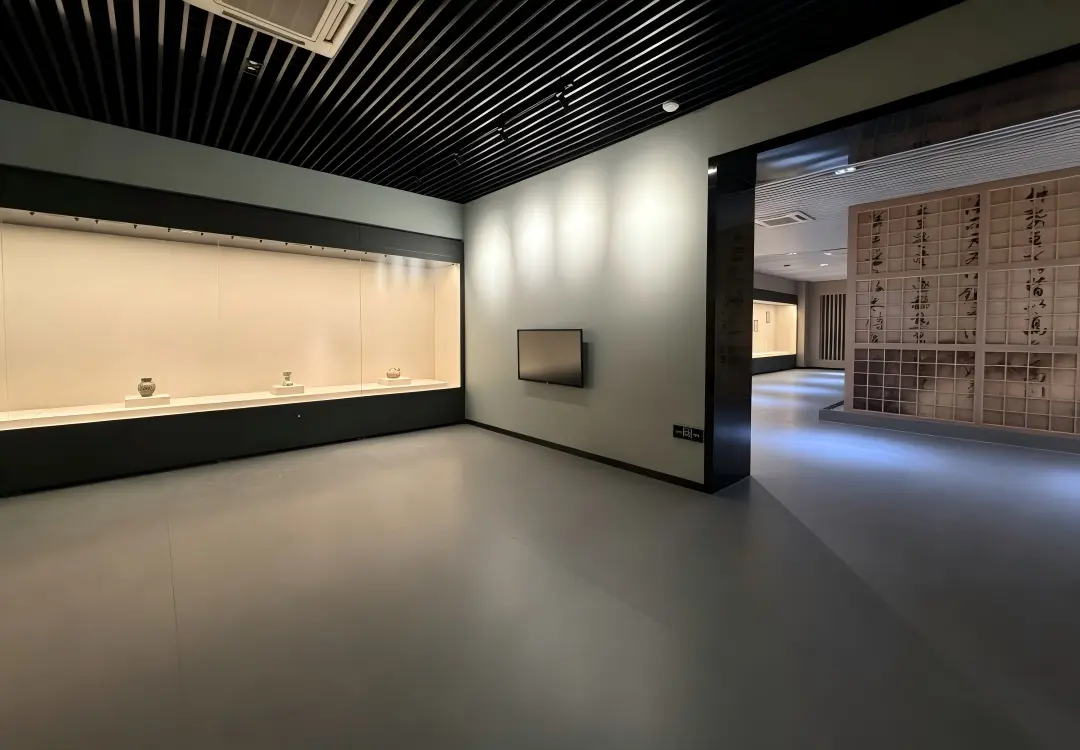
Specifying a true museum conservation display case means refusing to treat the enclosure as decorative furniture. On our assembly floor we read each case as an isolated pressure vessel – a sealed microclimate engineered to slow the irreversible entropy acting on organic textiles, iron-age alloys, and tempera pigments. The physics of airtightness, not the cabinetry, dictates every welding, gasket, and fastener decision we make.
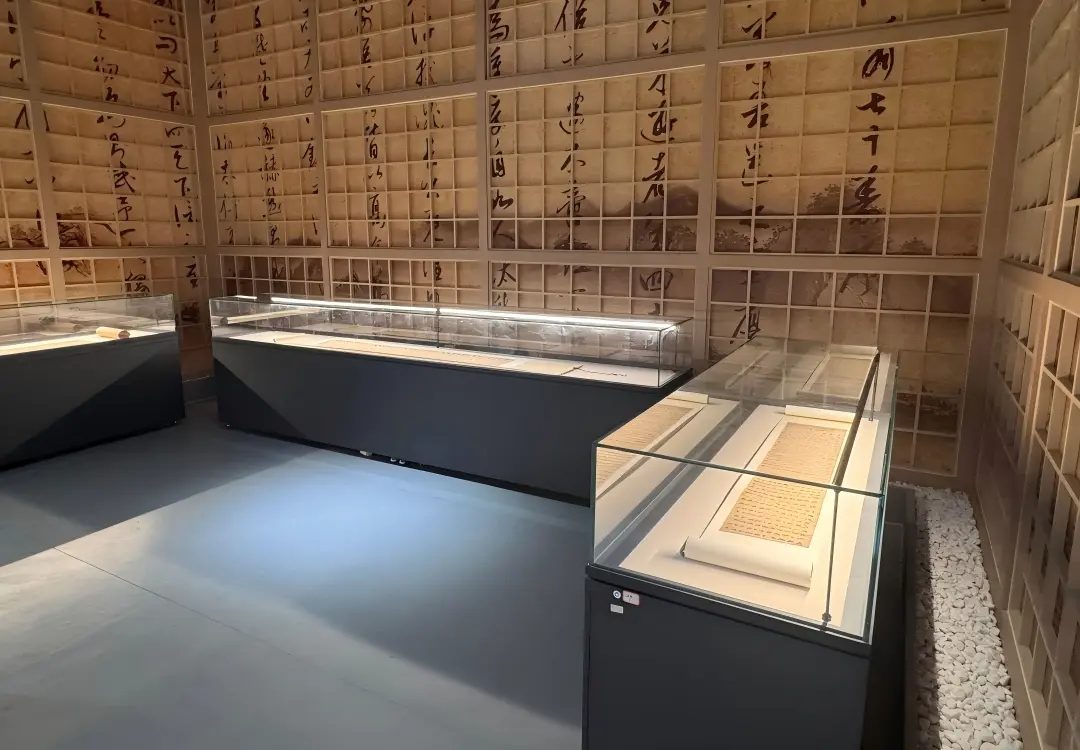
Why Does Air Exchange Rate Dictate Microclimate Stability in a Museum Conservation Display Case?
The bottleneck in artifact preservation is rarely the humidity inside the case. It is the unconditioned gallery air that keeps trying to get in.
Atmospheric pressure swings push ambient humidity, sulfur dioxide, and fine particulate matter through every microscopic gap in the cabinet framing. To hold internal relative humidity (RH) inside a strict +/-2% tolerance, the enclosure has to hit an Air Exchange Rate (AER) below 0.1 vol/day – and for sensitive objects like vellum or corroded iron, we target 0.05 vol/day. Anything looser and the desiccant carousel becomes a band-aid rather than a buffer.
Hitting that number is not a gasket problem alone. It is a system problem. Cold-drawn aluminum profiles must resist flex under heavy glass loads, or the mullion geometry shifts and the gasket compression map drifts. We run closed-cell EPDM and silicone gasket loops – precision-mitered, continuous, calibrated to Shore A 40-50 – so the elastomer keeps its memory under years of compression. Multi-point mechanical latches then distribute the load, killing the localized gasket failure that always shows up first at the corners.
I will not sign off a seal design until it has passed helium-leak or tracer-gas decay testing on the shop floor. Theoretical AER ratings are a lie when the gasket was hand-fitted.
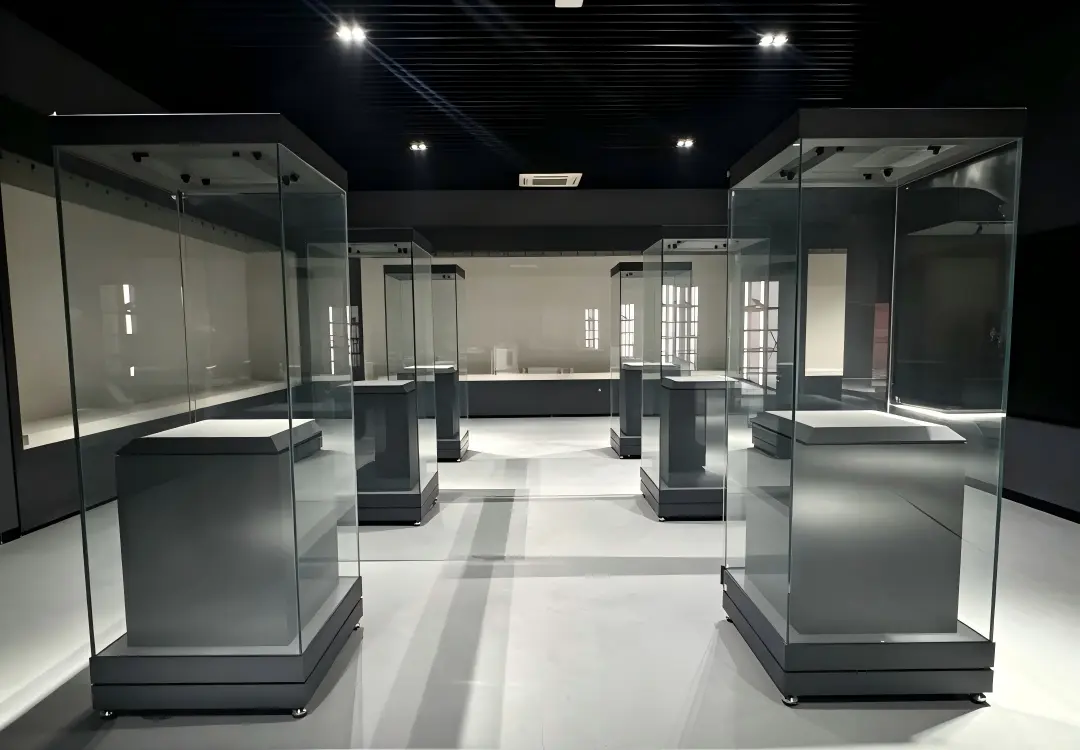
How Do Glazing Choices Balance Artifact Preservation Against Optical Clarity?
Glazing on museum quality display cases is a three-way negotiation between physical security, chemical stability, and optical neutrality. Standard float glass loses all three negotiations. Its iron oxide impurities cast a green tint that distorts the spectral response of displayed artifacts, and unlaminated tempered glass shatters into small cubes the moment a visitor leans on it.
For conservation work, extra-clear low-iron glass – iron content below 100 ppm – laminated with a polyvinyl butyral (PVB) or acoustic resin interlayer is the default. The PVB interlayer attenuates UV rays up to 400 nm by more than 99%, which is what stops photolytic degradation in pigments and organic materials. Annealed glass is not an option for public-facing cases, and I would not recommend acrylic for permanent museum installations either: it scratches, it holds static dust, and its moisture vapor transmission rate is higher than curators are usually told. The choice between glass or acrylic is, in our shop, not a choice at all.
| Parameter | Standard Tempered Glass | Low-Iron Laminated Safety Glass |
| Optical transmission | ~88%, visible green cast | >98% with magnetron AR coating |
| UV attenuation | Poor, under 300 nm only | >99%, blocked to 400 nm via PVB |
| Security grade | Low – cubes under impact | EN 356 P4A-P6B anti-burglary |
The anti-reflective coating is where most suppliers quietly cut corners. Done correctly, multi-layer magnetron sputtering deposits metal oxide layers that drop surface reflectance from roughly 8% to under 1% – close to invisible glazing with no glare on the displayed objects. We verify transmission against EN 410 before sign-off. Polished edges and beveled profiles are not cosmetic; they are how you prevent stress concentrations that turn a 200 kg glass panel into physical damage waiting to happen.
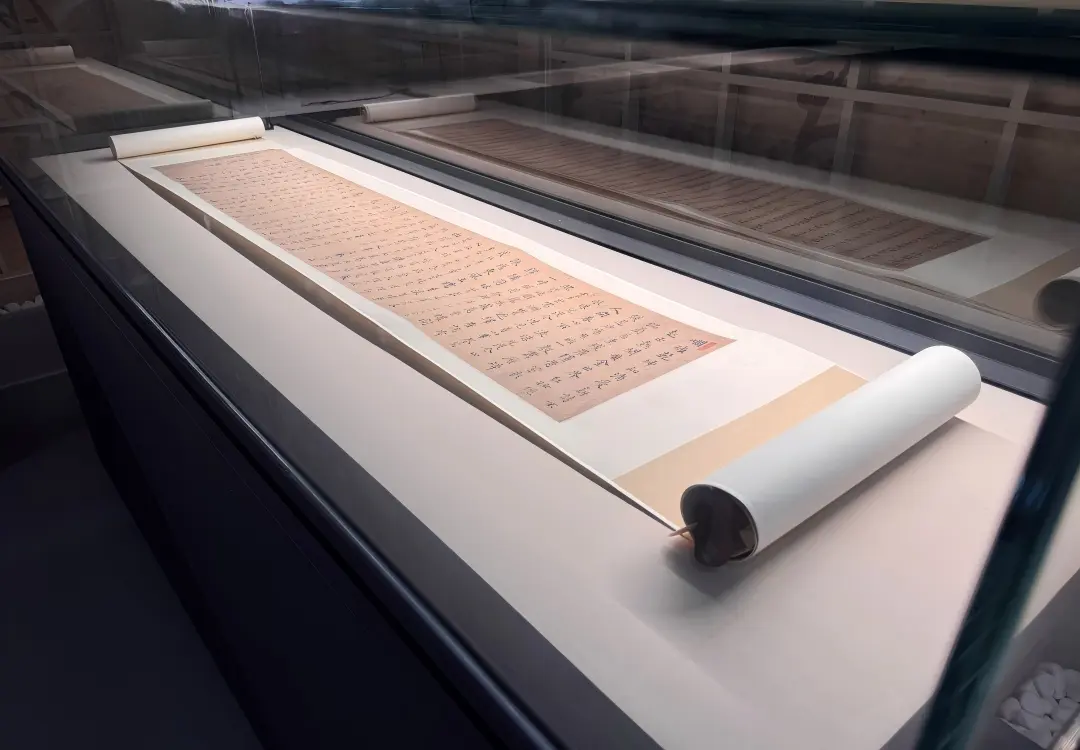
What Mechanical Standards Guarantee Safety in Large Freestanding Display Cabinets?
When a single glass panel passes 200 kg, manual swing doors become a hazard to staff and to the valuable artifacts they are supposed to protect. The structural integrity of large freestanding display cases depends on distributing mechanical stress across the base chassis, not concentrating it at the hinge.
For heavy high-value installations, we specify an Caixa independente com controle elétrico. Electromechanical linear actuators let one technician open a five-meter glass facade by remote – smooth, parallel, no torque on the glass edge, no strain on the gasket interface. That same Caixa independente com controle elétrico platform lets us wire an automated sealing sequence straight into the active microclimate module, so airflow rebalances the instant the door reseats.
Custom glass enclosures from Museo integrate floor-loading calculations, vibration-dampening anchors, and concealed shear-pin safety locks into the base. Our Museo engineering shop also runs a 0.2 mm flatness recheck on every butt-joint weld after cooling, because a frame that looks square when hot is rarely square the next morning.
How Do We Eliminate Off-Gassing and VOC Risks Inside Case Interiors?
The most common cause of artifact deterioration inside airtight enclosures is the case itself.
Materials that are benign in an open exhibition gallery turn lethal once sealed into a low-AER enclosure. Acetic acid, formic acid, and formaldehyde accumulate until they corrode lead, silver, and copper – sometimes within months, not years, and the object’s historical integrity is gone. Every material proposed for case interiors at our shop goes through the Oddy Test: a 28-day accelerated corrosion trial at 60 °C with lead, silver, and copper coupons sharing a sealed tube with the sample. Lead catches organic acids, silver catches reduced sulfur compounds, copper catches oxide and chloride contamination. Pass, temporary pass, or fail – there is no fourth option.
To keep the interior chemistry inert, we anodize or powder-coat aluminum with zero-VOC thermal curing instead of solvent-borne paint. Structural sealants are neutral-curing, solvent-free silicone with no acetic acid or amine carriers. Particleboard and standard MDF are eliminated in favor of aluminum honeycomb panels. Conservation-grade fabrics – pure washed silk, unbleached linen, solvent-free polyester – are bonded with heat-seal adhesives rather than liquid glues. These are not upgrades. They are baseline display case specifications.
Passive Buffering or Active Microclimate – How Do You Choose Museum-Quality Display Cases for Sensitive Objects?
Passive humidity control relies on pre-conditioned silica gel or ProSorb sitting in an isolated lower desiccant tray, with perforated convection channels through the plinth. It is invisible, silent, and right for stable galleries with well-sealed microclimate display cases.
Active microclimate units earn their cost when the gallery HVAC fluctuates seasonally, when the internal volume outruns what passive media can buffer, or when the object is organic and unforgiving. Thermo-electric or compressor-based units deliver filtered, humidity-controlled air through a closed-loop pneumatic line, and continuous wireless RH and temperature sensors feed the building management system (BMS) so curators are warned long before light levels, RH, or temperature thresholds are breached.
The honest engineering question is never “active or passive?” – it is “how stable is the gallery, and how fragile is the object?” Everything else, including the customization and configuration of the climate control loop, follows from those two answers.
FAQs
What is the ideal Air Exchange Rate (AER) for a museum conservation display case?
Under 0.1 vol/day is the standard benchmark. For ancient manuscripts or corroded iron artifacts, target 0.05 vol/day to minimize climate-control load and block pollutant ingress.
How does low-iron anti-reflective glass compare to standard laminated glass?
Standard float glass carries iron impurities that cast a green tint and reflects roughly 8% of ambient light. Low-iron glass with a magnetron-sputtered anti-reflective coating pushes transmission past 98% and cuts reflection below 1%.
Why is the Oddy Test mandatory for case interiors?
In an airtight microclimate, VOCs from paints, adhesives, and wood products accumulate and corrode metals, pigments, and fibers. The 28-day Oddy Test at 60 °C simulates long-term exposure before the material ever touches an artifact.
When should a museum choose active microclimate control over passive silica gel?
Passive media suit stable, well-sealed cases. Active units are warranted when gallery RH swings seasonally, when handling delicate organic artifacts, or when case volume exceeds what passive buffering can hold.
How do motorized opening systems preserve seal integrity on large glass enclosures?
Synchronized linear actuators move heavy doors along fixed parallel axes, applying uniform pressure across every perimeter gasket on each close – eliminating the uneven wear that manual swing doors cause over time.